Big Data, Hadoop and Distributive Cluster Storage
So before we get into Big Data, Hadoop and Distributive Cluster Storage.,Let us know about what is Data.
Since the invention of computers, people have used the term data to refer to computer information, and this information was either transmitted or stored. But that is not the only data definition; there exist other types of data as well. So, what is the data? Data can be texts or numbers written on papers, or it can be bytes and bits inside the memory of electronic devices, or it could be facts that are stored inside a person’s mind.
Now, if we talk about data mainly in the field of science, then the answer to “what is data” will be that data is different types of information that usually is formatted in a particular manner. All the software is divided into two major categories, and those are programs and data. Programs are the collection made of instructions that are used to manipulate data.
Types and Uses of Data:
Growth in the field of technology, specifically in smartphones has led to text, video, and audio is included under data plus the web and log activity records as well. Most of this data is unstructured.
The term Big Data is used in the data definition to describe the data that is in the petabyte range or higher. Big Data is also described as 5Vs: variety, volume, value, veracity, and velocity. Nowadays, web-based eCommerce has spread vastly, business models based on Big Data have evolved, and they treat data as an asset itself. And there are many benefits of Big Data as well, such as reduced costs, enhanced efficiency, enhanced sales, etc.
The meaning of data expands beyond the processing of data in computing applications. When it comes to what data science is, a body made of facts is called data science. Accordingly, finance, demographics, health, and marketing also have different meanings of data, which ultimately make up different answers for what data means.
How data is stored?
Computers represent data, including video, images, sounds and text, as binary values using patterns of just two numbers: 1 and 0. A bit is the smallest unit of data, and represents just a single value. A byte is eight binary digits long. Storage and memory is measured in megabytes and gigabytes.
The units of data measurement continue to grow as the amount of data collected and stored grows. The relatively new term "brontobyte," for example, is data storage that is equal to 10 to the 27th power of bytes.
So Here's the big question, How is such Big Data in terms of PetaBytes and BronoBytes is stored, processed just in seconds and less than in a second?
So now let's talk about Big Data:
Big Data is also data but with a huge size. Big Data is a term used to describe a collection of data that is huge in volume and yet growing exponentially with time. In short such data is so large and complex that none of the traditional data management tools are able to store it or process it efficiently.
Examples Of Big Data:
Following are some the examples of Big Data:
The New York Stock Exchange generates about one terabyte of new trade data per day.

Social Media
The statistic shows that 500+terabytes of new data get ingested into the databases of social media site Facebook, every day. This data is mainly generated in terms of photo and video uploads, message exchanges, putting comments etc.

A single Jet engine can generate 10+terabytes of data in 30 minutes of flight time. With many thousand flights per day, generation of data reaches up to many Petabytes.

Types Of Big Data:
BigData could be found in three forms:
- Structured
- Unstructured
- Semi-structured
Structured:
Any data that can be stored, accessed and processed in the form of fixed format is termed as a 'structured' data. Over the period of time, talent in computer science has achieved greater success in developing techniques for working with such kind of data (where the format is well known in advance) and also deriving value out of it. However, nowadays, we are foreseeing issues when a size of such data grows to a huge extent, typical sizes are being in the rage of multiple zettabytes.
Unstructured:
Any data with unknown form or the structure is classified as unstructured data. In addition to the size being huge, un-structured data poses multiple challenges in terms of its processing for deriving value out of it. A typical example of unstructured data is a heterogeneous data source containing a combination of simple text files, images, videos etc. Now day organizations have wealth of data available with them but unfortunately, they don't know how to derive value out of it since this data is in its raw form or unstructured format.
Semi-structured:
Semi-structured data can contain both the forms of data. We can see semi-structured data as a structured in form but it is actually not defined with e.g. a table definition in relational DBMS. Example of semi-structured data is a data represented in an XML file.
Data Growth over the years:

Characteristics Of Big Data:
(i) Volume – The name Big Data itself is related to a size which is enormous. Size of data plays a very crucial role in determining value out of data. Also, whether a particular data can actually be considered as a Big Data or not, is dependent upon the volume of data. Hence, 'Volume' is one characteristic which needs to be considered while dealing with Big Data.
(ii) Variety – The next aspect of Big Data is its variety.
Variety refers to heterogeneous sources and the nature of data, both structured and unstructured. During earlier days, spreadsheets and databases were the only sources of data considered by most of the applications. Nowadays, data in the form of emails, photos, videos, monitoring devices, PDFs, audio, etc. are also being considered in the analysis applications. This variety of unstructured data poses certain issues for storage, mining and analyzing data.
(iii) Velocity – The term 'velocity' refers to the speed of generation of data. How fast the data is generated and processed to meet the demands, determines real potential in the data.
Big Data Velocity deals with the speed at which data flows in from sources like business processes, application logs, networks, and social media sites, sensors, Mobile devices, etc. The flow of data is massive and continuous.
(iv) Variability – This refers to the inconsistency which can be shown by the data at times, thus hampering the process of being able to handle and manage the data effectively.
Benefits of Big Data Processing:
Ability to process Big Data brings in multiple benefits, such as-
- Businesses can utilize outside intelligence while taking decisions
Access to social data from search engines and sites like facebook, twitter are enabling organizations to fine tune their business strategies.
- Improved customer service
Traditional customer feedback systems are getting replaced by new systems designed with Big Data technologies. In these new systems, Big Data and natural language processing technologies are being used to read and evaluate consumer responses.
- Early identification of risk to the product/services, if any
- Better operational efficiency
Big Data technologies can be used for creating a staging area or landing zone for new data before identifying what data should be moved to the data warehouse. In addition, such integration of Big Data technologies and data warehouse helps an organization to offload infrequently accessed data.
What is Hadoop?
Hadoop is developed by Doug Cutting and Michale J. It is managed by apache software foundation and licensed under the Apache license 2.0 Hadoop is very useful for the big business because it is based on cheap servers so it required less cost to store the data and processing the data. Hadoop helps to make a better business decision by providing a history of data and various record of the company, So by using this technology company can improve its business. Hadoop does lots of processing over collected data from the company to deduce the result which can help to make a future decision.
Uses of Hadoop:
1.Security and Law Enforcement
2.Customer’s Requirements Understanding
3.Cities and Countries Improvement
4.Financial Trading and Forecasting
5.Understanding and Optimizing Business Processes
6.Personal Quantification and Performance Optimization
7.Improving Healthcare and Public Health
8.Optimizing Machine Performance
9.Improving Sports
10.Improving Science and Research
HDFS Architecture:
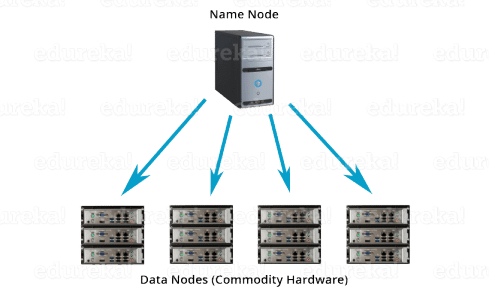
Apache HDFS or Hadoop Distributed File System is a block-structured file system where each file is divided into blocks of a pre-determined size. These blocks are stored across a cluster of one or several machines. Apache Hadoop HDFS Architecture follows a Master/Slave Architecture, where a cluster comprises of a single NameNode (Master node) and all the other nodes are DataNodes (Slave nodes). HDFS can be deployed on a broad spectrum of machines that support Java. Though one can run several DataNodes on a single machine, but in the practical world, these DataNodes are spread across various machines.
NameNode:

NameNode is the master node in the Apache Hadoop HDFS Architecture that maintains and manages the blocks present on the DataNodes (slave nodes). NameNode is a very highly available server that manages the File System Namespace and controls access to files by clients. I will be discussing this High Availability feature of Apache Hadoop HDFS in my next blog. The HDFS architecture is built in such a way that the user data never resides on the NameNode. The data resides on DataNodes only.
Functions of NameNode:
- It is the master daemon that maintains and manages the DataNodes (slave nodes)
- It records the metadata of all the files stored in the cluster, e.g. The location of blocks stored, the size of the files, permissions, hierarchy, etc.
DataNode:
DataNodes are the slave nodes in HDFS. Unlike NameNode, DataNode is a commodity hardware, that is, a non-expensive system which is not of high quality or high-availability. The DataNode is a block server that stores the data in the local file ext3 or ext4.
Secondary NameNode:
Apart from these two daemons, there is a third daemon or a process called Secondary NameNode. The Secondary NameNode works concurrently with the primary NameNode as a helper daemon. And don’t be confused about the Secondary NameNode being a backup NameNode because it is not.

Conclusion:
The availability of Big Data, low-cost commodity hardware, and new information management and analytic software have produced a unique moment in the history of data analysis. The convergence of these trends means that we have the capabilities required to analyze astonishing data sets quickly and cost-effectively for the first time in history. These capabilities are neither theoretical nor trivial. They represent a genuine leap forward and a clear opportunity to realize enormous gains in terms of efficiency, productivity, revenue, and profitability.
The Age of Big Data is here, and these are truly revolutionary times if both business and technology professionals continue to work together and deliver on the promise.
Hadoop is playing a very important role in today’s life can be fit with any domain as per requirement we can adopt this technology in our organization as per our business requirement.It is a powerful system developed as a platform to support an enormous quantity of varied data applications. It provides an interface to process both structured and complex data thus facilitating heterogeneous data consolidation. The open source feature of Hadoop makes its commodity servers cheaper to use accompanied with improved performance ratio. The Map/Reduce framework offers users the flexibility to manipulate the methods of analysing their data.
In the world today where millions of users interact with each other through social networking media or bulky statistical records, the heavy data inflow requires systems such as Hadoop to analyse and persist them. By hosting Hadoop onto the cloud framework, we can successfully take the current level of data management into a wider seamless and global dimension.

Comments
Post a Comment